Friday, July 31, 2026From the news
When Memory Becomes Mercy
Standing before the wounds of history, we are invited to repent with gentle courage and to let God’s mercy heal what human sin has broken.
God created mankind in his image; in the image of God he created them; male and female he created them.
Genesis 1:27
Have mercy on me, God, in accord with your merciful love; in your abundant compassion blot out my transgressions. Thoroughly wash away my guilt; and from my sin cleanse me.
Psalm 51:3-4
And all this is from God, who has reconciled us to himself through Christ and given us the ministry of reconciliation, namely, God was reconciling the world to himself in Christ, not counting their trespasses against them and entrusting to us the message of reconciliation.
2 Corinthians 5:18-19
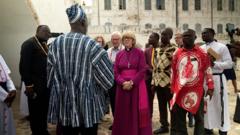
This week the news carried us, in spirit, to the dark dungeons of Cape Coast Castle in Ghana. There the Archbishop of Canterbury walked through rooms where men, women, and children once waited in terror before being forced through the “door of no return.” Above those dungeons sat a chapel. The contrast is almost too painful to bear: sacred song rising while human beings made in God’s image were chained below. The archbishop spoke of being “deeply moved” and of the Church’s need for repentance that becomes concrete action. Whatever debates surround particular funds or historical judgments, the human ache remains: a wound that still cries out across centuries.
We Catholics know this ache in our own story too. The Church has never been free of sinners, and history records moments when baptized people failed the very Gospel they preached. Yet our faith does not leave us trapped in shame. It leads us gently to the heart of Christ, who never turns away from the broken. Scripture opens with the truth that every person—African, European, Caribbean, every soul—bears the indelible image of God. That dignity was never erased by chains or by the sins of those who forged them. It remains, luminous and unbreakable, calling us still to reverence.
When we hear of historical evils, the temptation can be either to look away or to grow hard with accusation. The Psalmist shows us another way. “Have mercy on me, God… blot out my transgressions.” Repentance is not self-loathing; it is the quiet turning of the heart toward the One who already loves us. It is the courage to say, “We were wrong,” and then to ask how love might begin to repair what hatred and greed destroyed. The Catechism reminds us that sin has social consequences, and that conversion includes works of justice and charity that seek to heal those wounds. This is not about scoring points or settling scores. It is about letting mercy do its slow, patient work.
Saint Paul tells us that God has given us the ministry of reconciliation. That ministry begins not with grand pronouncements but with the simple recognition that every person who suffered under slavery was a brother or sister for whom Christ died. It continues whenever we refuse to let the past be forgotten, yet also refuse to let it have the last word. The resurrection is God’s final answer to every dungeon and every door of no return. Death and degradation do not win. Love does.
So today, if the news leaves you heavy, take heart. The Lord sits with those who grieve the sins of history. He sits with the descendants who still carry the weight of that legacy. And He sits with us, inviting us not to despair but to walk the path of mercy—confessing honestly, acting gently, and trusting that the same God who formed us in His image is still making all things new. Let us rest in that nearness. We do not carry the world’s wounds alone.
Prayer
Merciful Father, You see every tear shed in forgotten dungeons and every wound still open in the human family. Pour Your healing love upon all who bear the legacy of slavery, and give us humble hearts that repent and seek to repair. Through Christ our Lord. Amen.