Saturday, August 1, 2026From the news
Near the Breakwater, the Lord Draws Close
In the sorrow of Ceuta’s overcrowded shores and the lives lost at the border, Christ draws near to the suffering and calls us to mercy that honors every person’s dignity.
The Lord is close to the brokenhearted, saves those whose spirit is crushed. Many are the troubles of the just, but the Lord delivers from them all.
Psalm 34:18-19
For I was hungry and you gave me food, I was thirsty and you gave me drink, a stranger and you welcomed me, naked and you clothed me, ill and you cared for me, in prison and you visited me... Amen, I say to you, whatever you did for one of these least brothers of mine, you did for me.
Matthew 25:35-36, 40
Let mutual love continue. Do not neglect hospitality, for through it some have unknowingly entertained angels.
Hebrews 13:1-2
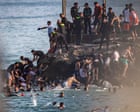
This week the news from Ceuta reaches us with heavy hearts. Tens of thousands of people crossed from Morocco into the small Spanish enclave in a single day. At least fifty-seven died—some by drowning, others crushed in the press at the Tarajal breakwater. Families, young men, women, and unaccompanied children found themselves without shelter, sleeping in parks and on pavements. Local voices spoke of chaos and a serious humanitarian crisis. Many have since returned; authorities work to restore order. Yet the images remain: belongings floating in the sea, crowds seeking a foothold of safety, and lives cut short at the water’s edge.
We do not stand at a distance from such sorrow. The Church teaches us that every human person bears the image of God, and no border erases that sacred dignity. When we hear of those who perished or who wandered exhausted through the streets, the words of the psalmist come gently: “The Lord is close to the brokenhearted, saves those whose spirit is crushed.” God does not abandon the ones who feel crushed by fear, poverty, or the long road of displacement. He is near—nearer than the waves, nearer than the fences, nearer than our own bewilderment.
Jesus himself identifies with the stranger. In Matthew’s Gospel he tells us that when we welcome the hungry, the thirsty, the stranger, we welcome him. This is not a political program; it is the quiet truth of the Incarnation. The Son of God came among us poor and vulnerable. He knows what it is to have no place to lay his head. In Ceuta’s parks and on its roads, Christ is present in those who suffer. Our first response is not argument but compassion—prayer for the dead, tears for the living, and a steady refusal to look away.
Catholic social teaching reminds us of solidarity: we are one human family. The Catechism calls us to see the migrant not as a problem first, but as a person whose rights and needs claim our conscience. Saints like Vincent de Paul and Frances Xavier Cabrini spent their lives among the uprooted, trusting that mercy multiplies when shared. Mary, who fled with Joseph and the Child into Egypt, stands as mother of all who journey in fear. Her trust invites ours.
Let us remember, then, those who died at the breakwater and those still waiting in uncertainty. Let us hold the people of Ceuta—residents and newcomers alike—in the light of Christ’s peace. Take heart: the God who saves the crushed in spirit has not withdrawn. He remains close. In the Eucharist he feeds us so that we may become bread for one another. In quiet prayer and simple acts of kindness, wherever we are, we can answer his call to hospitality. Through it, Scripture says, some have entertained angels unawares. May our hearts remain open, our hope unbroken, and our love steadfast, even when the news is hard.
Prayer
Merciful Father, draw near to all who suffer in Ceuta and along every difficult border. Comfort the grieving, protect the vulnerable, and give wisdom and compassion to those who serve them. Through the intercession of Mary, Mother of migrants, keep us faithful to the dignity of every person, and let your peace rest upon us all. Amen.