Friday, July 31, 2026From the news
Beneath the Chapel: Mercy at the Door of Return
Standing before the wounds of history, we are invited into the quiet work of repentance, where Christ’s mercy meets the pain of the past and opens a way toward healing and restored dignity.
Have mercy upon me, O God, according to Thy great mercy; and according to the multitude of Thy compassions blot out my transgression. Wash me thoroughly from mine iniquity, and cleanse me from my sin.
Psalm 50:3-4 (51:1-2)
Is not this the fast that I choose: to loose the bonds of wickedness, to undo the thongs of the yoke, to let the oppressed go free, and to break every yoke? Is it not to share your bread with the hungry, and bring the homeless poor into your house?
Isaiah 58:6-7
For godly grief produces a repentance that leads to salvation and brings no regret, but worldly grief produces death.
2 Corinthians 7:10
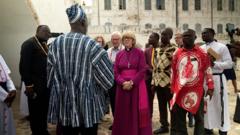
In Cape Coast, Ghana, an archbishop walked through dungeons where men, women, and children once waited in darkness before being forced through a door that history has named the door of no return. Above those cells stood a chapel. The contrast is almost too heavy to bear: prayer rising while human beings suffered beneath the floorboards. Dame Sarah Mullally said the place threw her off balance and brought home the evil of the transatlantic slave trade. She spoke of the Church’s part in it, and of repentance that becomes action—a fund meant to serve communities still carrying the long shadow of that cruelty.
We do not stand in judgment of another communion’s debates. We simply pause with the human reality: the memory of chains, the grief that still lives in bodies and soils across oceans, and the longing for some sign that the past has been seen and named. In the Orthodox heart, repentance is never a performance or a calculation. It is a return to life. It is the soul turning, again and again, toward the face of Christ who never stopped looking upon the afflicted.
The Psalmist teaches us the first words of that turning: “Have mercy upon me, O God, according to Thy great mercy.” These are not words for private faults alone. They can be prayed over the sins of the generations, over the ways our human institutions—churches among them—have failed the image of God in the neighbor. Godly grief, Saint Paul tells us, produces a repentance that leads to salvation and brings no regret. It is not self-hatred. It is the honest acknowledgment that something holy was violated, followed by the quiet resolve to live differently.
Isaiah’s voice still sounds across the centuries: the fast the Lord chooses is to loose the bonds of wickedness, to let the oppressed go free, to share bread and open the house. True repentance has hands. It does not erase history; it refuses to let history have the last word. The door that once meant no return can become, in Christ, a place where memory is held in mercy and where dignity is reaffirmed. Every person who passed through those dungeons bore the light of the divine image. That light was never extinguished, though the world tried to bury it.
The Fathers remind us that the heart is deep, and that healing is slow. Saint John Chrysostom spoke of almsgiving and justice as the natural fruit of a soul that has met God’s compassion. The Desert Fathers knew that tears over sin—personal or ancestral—are not weakness but the beginning of freedom. We cannot undo what was done. We can, however, refuse to forget, and we can ask the Holy Spirit to make of our sorrow a gentle strength that serves the living.
Take heart. The same Christ who descended into the lowest places walks still among the wounded of history. His mercy is larger than our failures. His resurrection proclaims that no human being is ever finally discarded. In the quiet after Vespers we may hold the pain of Cape Coast and of every place like it, and rest in the promise that God is near to the brokenhearted. Let us remember those who suffered. Let us pray for those who still carry the legacy. And let us trust that repentance, when it is real, becomes a doorway—not of departure, but of return to one another and to the God who makes all things new.
Prayer
Lord Jesus Christ, who descended into the depths and raised the fallen, have mercy on all who still bear the wounds of injustice and bondage. Grant us tender hearts that remember with truth and act with compassion, and let Your light shine upon every place where dignity was denied. Through the prayers of Your saints, heal what we cannot heal, and draw us all into the freedom of Your Kingdom. Amen.